熊出没之夺宝熊兵
Chinese firm’s Lixun-1 ‘space tug’ eyes maiden flight in Q1 2027 after key propulsion tests_我的网站

A |
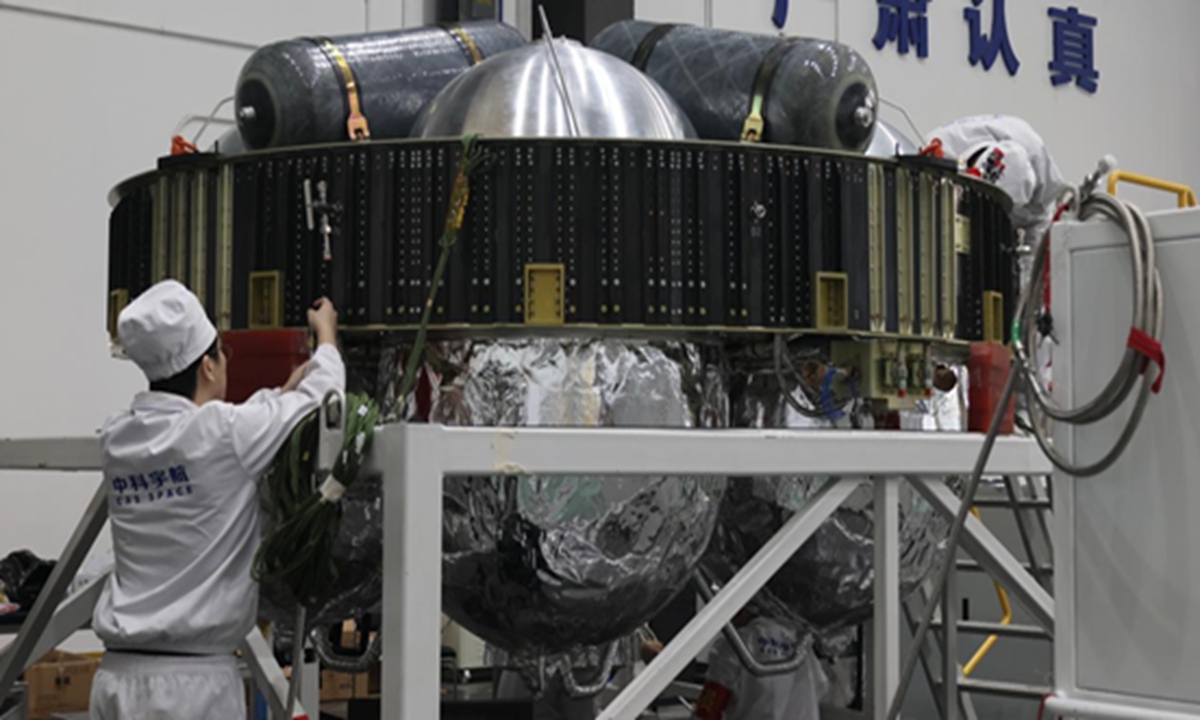
The general assembly of the Lixun-1 upper stage Photo: Courtesy of CAS Space
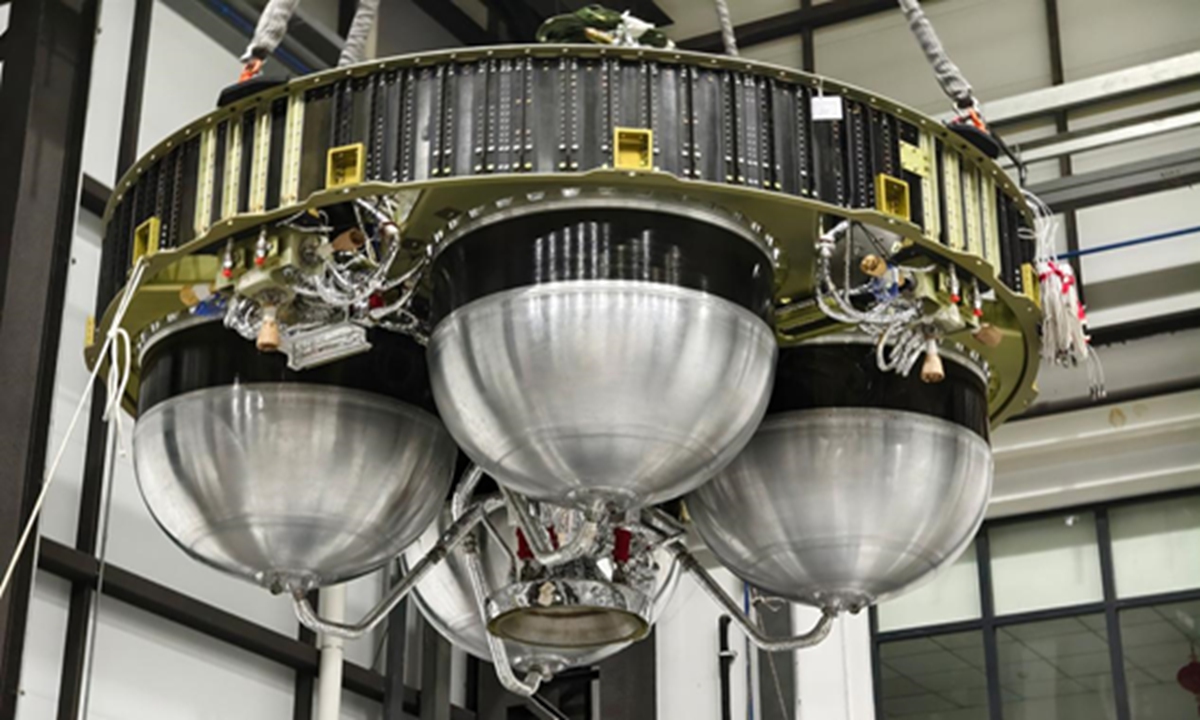
The Lixun-1 upper stage Photo: Courtesy of CAS Space
Lixun-1 upper stage, a versatile "space tug" developed by China's commercial space firm CAS Space, is scheduled to make its maiden flight in the first quarter of 2027 after completing a series of key propulsion-system tests, the developer and its chief designer told the Global Times on Tuesday.
The "tug" is designed to ferry satellites from one orbit to another and support missions ranging from constellation deployment to lunar exploration.
While the main stages of a rocket carry payloads from the ground into an initial orbit, an upper stage takes over once the craft is in space. By repeatedly restarting its engine and changing orbit, Lixun-1 can deliver satellites to higher or different orbits, distribute multiple spacecraft to separate destinations during a single launch, or send probes onto trajectories toward the moon and beyond, Global Times learned from the developer.
Yang Haoliang, chief designer of the Lixun-1 upper stage, compared the system to a shuttle service. "If the regular stages of a launch vehicle are like a long-distance bus," - they carry the upper stage and satellites from Earth to a near-Earth parking orbit - the upper stage then takes over as a "space tug," carrying its satellite "passengers" onward to their designated orbital "stops," Yang explained.
That capability can have a direct impact on how efficiently satellites are launched and operated, Yang said. If a satellite has to climb from an initial orbit to its final destination using its own engine, the process can consume a considerable amount of onboard propellant and reduce the fuel available during its operational life. An upper stage can instead perform that orbital transfer, helping conserve satellite fuel and potentially extend its service life.
It can also make one rocket launch do more work. Instead of releasing a batch of satellites into roughly the same orbit, Lixun-1 can repeatedly ignite its engine and maneuver between deployments, sending different satellites to different altitudes and inclinations. Yang said this would help accelerate constellation deployment while improving the efficiency of individual launches.
The practical ambitions behind the system are backed by a major technical milestone reached this month. In August, Lixun-1 completed its PV-001 integrated propulsion-system coordination firing test, during which the entire system operated smoothly for 566 seconds.
Yang told the Global Times that the current Lixun-1 upper stage has a thrust of 20 kilonewtons and can achieve a specific impulse of 315 seconds, which he described as reaching an internationally leading level. The August firing covered the planned profile for the maiden mission, an important step before the system proceeds to flight testing.
The test was more than a demonstration of the engine itself. As an important system-level verification during development, it examined the coordination and engineering reliability of the engine pressurization system, propellant delivery system, propellant management system and servo-control system under the fully integrated configuration.
Of a series of tests that accumulated 5,211 seconds of firing time, the latest one focused on three core technologies: a high-thrust, high-performance 20-kilonewton upper-stage engine capable of multiple starts; balanced propellant delivery from multiple parallel tanks; and a highly reliable integrated electrical system. Their successful verification means Lixun-1 has completed its system-level testing and is ready to move into the flight-test phase, according to the developer.
Lixun-1 has been designed as a modular and generally adaptable upper stage rather than a system tied to only one rocket. It is intended to work with CAS Space's Kinetica-2 and Kinetica-2 heavy-lift variants as well as other launch vehicles, Yang said.
When paired with the Kinetica-2 family, Lixun-1 could significantly expand the rocket's mission range. For communications missions, it could deliver satellites to geosynchronous transfer orbit or even directly to geosynchronous orbit, conserving satellite propellant while supporting the deployment of high-throughput satellites and future 6G communications spacecraft.
For multi-satellite missions, the combination could distribute spacecraft to different orbital altitudes and inclinations during a single launch, potentially serving both low-Earth-orbit constellations and medium- or high-orbit payloads. For deep-space missions, it could place probes onto Earth-moon transfer trajectories and support lunar exploration, Yang said.
The upper stage is designed to be able to conduct more than 20 engine ignitions, autonomously plan orbital-transfer routes and operate under the vacuum and extreme temperature conditions of space. After completing payload deployment, it can also carry out orbital disposal maneuvers to reduce space-debris risks.
Yang said the Lixun-1 and Kinetica-2 combination is designed to cover the vast majority of commercial satellite launch requirements while retaining the ability to participate in major national space projects. More broadly, the upper stage forms part of CAS Space's effort to build launch capabilities reaching medium and high Earth orbits and deep space, extending the reach of China's commercial space sector toward higher orbits and more distant destinations.
。 跟启发它的螃蟹一样,该机器人利用其各向异性的腿垂直挖掘颗粒状介质--各向异性允许材料在不同方向移动时表现出不同的特性。螃蟹有10条腿,而EMBUR只有4条。跟螃蟹的情况一样,机器人通过交替使用身体一侧的所有腿进行挖掘,然后再使用另一侧的所有腿进行扫荡。在EMBUR上,每条腿都采取了可延伸金属轴的形式,并有一条沿其纵向延伸的织物。当腿在“动力冲程”中离开机器人的身体时,它就会拉长并将织物拉紧--这使得织物的作用有点像一个篮子,能收集和置换颗粒状介质。当腿被拉回身体时它就会缩短,并导致织物下垂和穿过颗粒物,而不是收集它们。

B | 通过快速重复这些动作,EMBUR可以相对快速地埋葬自己。

C | 并且,机器人关节上的所有开口都覆有一层橡胶膜,这使得它们能自由移动,与此同时还能防止颗粒物进入并堵塞一切。在Hannah Stuart助理教授的领导下,科学家们现在正在努力使该机器人能在实际的沙子和泥土中挖掘。希望它的后代有一天能被用于评估农业和建筑工地的土壤并从洋底收集科学数据,甚至还可以作为海洋车辆或航天器的锚。
Current article:http://wa0i.runtunpaixufenjuduishuang.pics/news/20260826_62510.html
Published on:18:22:44

 苹果 iPhone 18 Pro/Max 爆料汇总:A20 芯片、可变光圈等
 IGN盛赞国产《湮灭之潮》:高速战斗很爽 还想再玩
 开展“红领巾爱祖国”系列活动
 连买两天!蔡崇信再增持约8200万港元阿里股票 两天累计增持1.6亿港元
 お嬢様大卒の二世タレント「徹子の部屋」で黒柳とまさかの“色かぶり” 衣装の色に配慮できず「反省」
 媒体人:投资人与杜锋有个拉锯的谈判过程 朱芳雨更多是知难而退
查看所有0条评论>>